
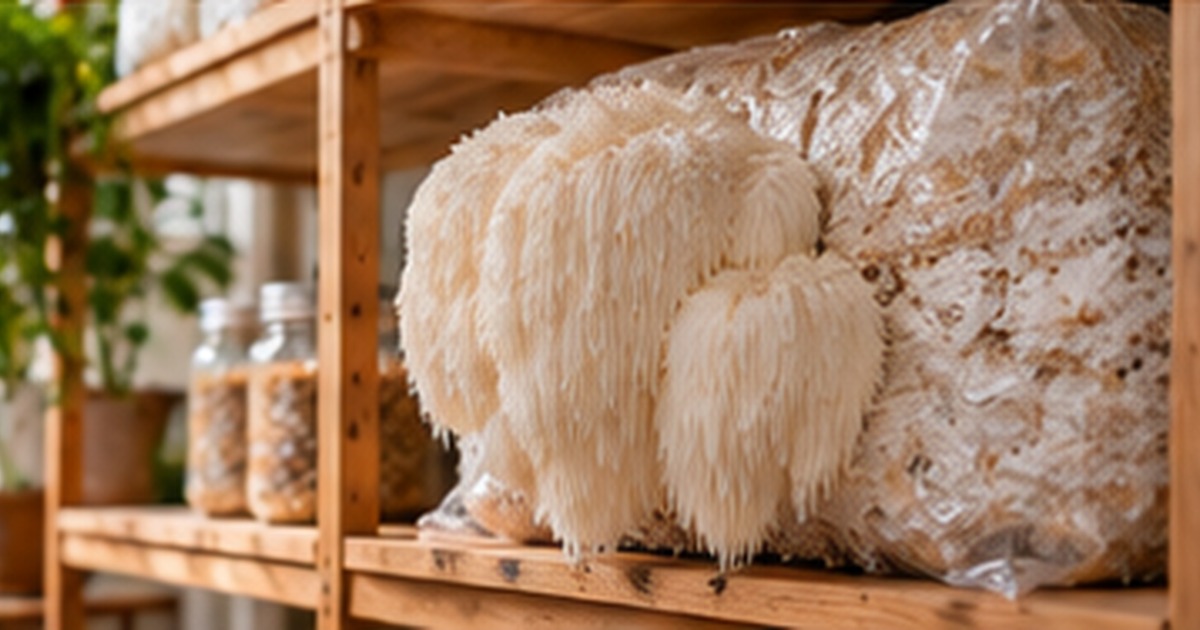
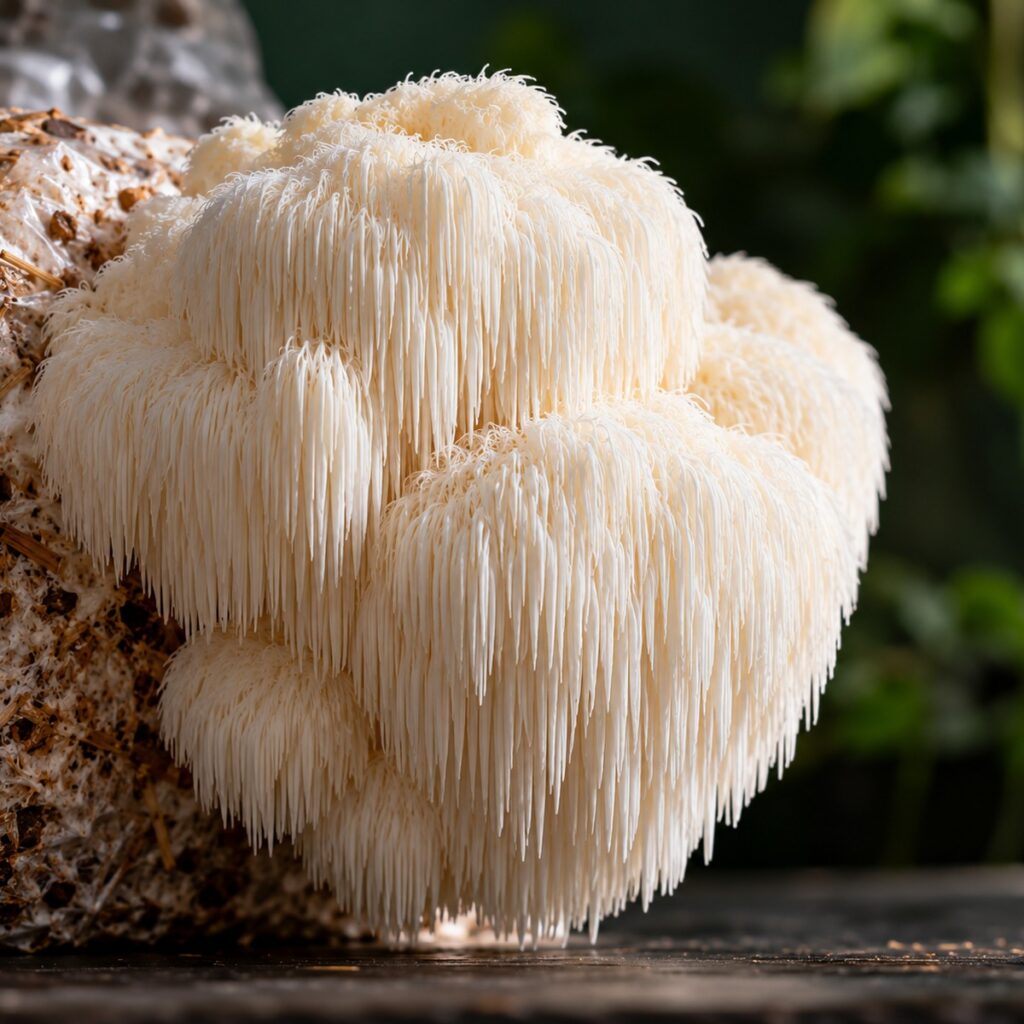
Lion’s mane (Hericium erinaceus) is one of the most rewarding gourmet mushrooms to grow at home. Instead of a cap and gills, it forms a white cascade of soft spines, and it tastes mild and slightly sweet, often compared to crab or lobster. It is also forgiving for beginners once you understand what it likes.
Two ways to start
A ready-to-fruit kit is the easiest route. It arrives as a block of hardwood sawdust already colonised by lion’s mane mycelium, so all you need to do is provide the right fruiting conditions.
Growing from spawn gives you more control. Mix lion’s mane grain spawn into supplemented hardwood sawdust, often with added wheat bran, in a filter-patch bag. Keep it dark at around 20 to 24°C until the block turns white, which usually takes two to four weeks. Lion’s mane mycelium is thinner than oyster’s, so a fully colonised block can look patchy. That is normal.
Fruiting conditions
- Temperature: 15 to 21°C. Cooler temperatures produce denser, whiter mushrooms.
- Humidity: 85 to 95%. Lion’s mane dries out easily, which turns the spines yellow or brown.
- Fresh air: a few air exchanges a day. Too little fresh air gives coral-like, branching growth instead of a single round head.
- Light: indirect daylight or a few hours of LED light. It does not need much.
Step by step
1. Open the bag. Cut a small X or a 2 to 3cm slit in the bag where you see the mycelium thickest or where small white bumps (primordia) are starting to form. Lion’s mane fruits from a single opening better than from a fully opened block.
2. Create humidity. Put the block in a humidity tent, a clear storage tub with a few holes, or a simple shotgun fruiting chamber. Mist the inside walls of the tent once or twice a day rather than spraying the mushroom directly, as standing water on the spines can cause brown spots.
3. Fan for fresh air. Open the tent and wave the lid a few times when you mist. Within a week or two, a small white knob should appear at the opening and start to develop spines.
4. Harvest. Pick lion’s mane when the spines are around 0.5 to 1cm long and before they start to yellow, usually 10 to 14 days after the first pins appear. Twist it off gently or cut it at the base with a clean knife.
Second flushes
After harvest, let the block rest for a week or two, then return it to fruiting conditions. Most blocks produce two or three flushes, each a little smaller than the last. You can also cut a new opening on the other side of the bag.
Troubleshooting
- Yellow or brown spines: too dry or too warm. Increase humidity and move somewhere cooler.
- Branching, coral-like growth: not enough fresh air. Fan more often.
- Pink tinge: usually a sign of cold or bright light. It is cosmetic, and the mushroom is still fine to eat.
- Nothing happening after three weeks: try a cold shock by placing the block in the fridge overnight, then return it to the tent.
Fresh lion’s mane keeps for up to a week in a paper bag in the fridge. It is best torn into pieces and pan-fried in butter until golden.
Leave a Reply