
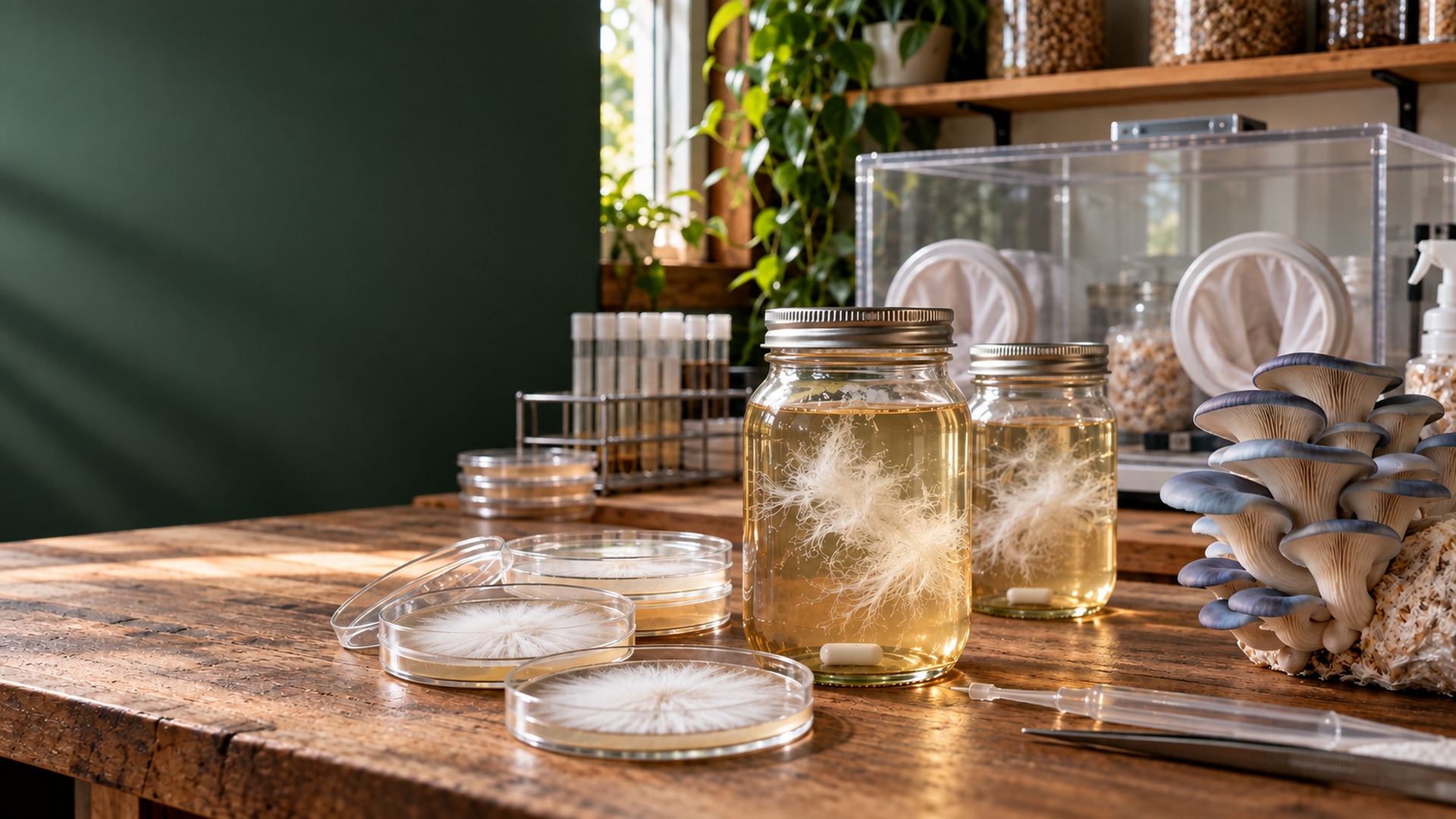
Growing gourmet mushrooms like oyster, lion’s mane and shiitake follows the same basic path whatever the species: you start with a culture, expand it onto grain, move it into a bulk substrate, and give it the conditions it needs to fruit. This overview explains each stage and points you to our detailed guides.
The core idea: expanding a culture
Mushrooms are the fruit of mycelium, a network of fine threads that grows through its food. Cultivation is the process of growing a large, healthy mass of mycelium before mould and bacteria can take hold, then triggering it to fruit. Each stage expands the culture onto more food, and each stage depends on clean technique.
Stage 1: Choose your starting point
There are four common ways to start:
- Spores from a swab or print. Every spore is genetically different, so germinating them produces a mix of strains. This is slower and less predictable, but it is how new strains are found.
- Liquid culture, living mycelium in a nutrient broth. It is fast and consistent because it comes from a single established strain.
- Agar culture, mycelium growing on a gel in a Petri dish. It lets you see contamination, choose the healthiest growth and keep strains long term.
- Tissue cloning, taking a piece of a healthy mushroom and growing it on agar. This copies the genetics of a mushroom you liked.
Stage 2: Agar (optional but powerful)
Many growers pass every culture through agar first. On a clear plate you can spot contamination early, cut away the cleanest and most vigorous growth, and make dozens of plates from one sample. Read our guide to working with agar.
Stage 3: Grain spawn
Sterilised grain, such as rye, wheat or millet, gives mycelium a dense, nutritious food to colonise quickly. You inoculate it with liquid culture or a piece of agar and incubate it until it turns white. Our liquid culture guide covers this step in detail.
Stage 4: Bulk substrate
Grain spawn is mixed into a larger, cheaper material that the species likes to eat:
- Oyster mushrooms are vigorous and grow well on pasteurised straw, coffee grounds or hardwood pellets.
- Lion’s mane and shiitake prefer sterilised hardwood sawdust supplemented with bran.
Pasteurising (heating to around 65 to 80°C) reduces competitors and suits aggressive species. Sterilising in a pressure cooker kills almost everything and is needed for richer, supplemented substrates.
Stage 5: Fruiting
Once the substrate is fully colonised, mushrooms are triggered by a change in conditions: more fresh air, high humidity, some light and often a drop in temperature. Each species has its own preferences. Our lion’s mane guide is a good worked example.
The golden rule: clean technique
Most failed grows come down to contamination. Work in still air, ideally in a still air box or in front of a flow hood, sterilise tools, wipe surfaces with 70% alcohol, and never open contaminated containers indoors. The earlier a stage is, the more careful you need to be.
Our growing guides cover edible gourmet species only. Cultivating psilocybin-containing mushrooms is illegal in the UK, and our microscopy spore samples are not sold for cultivation.
Leave a Reply