
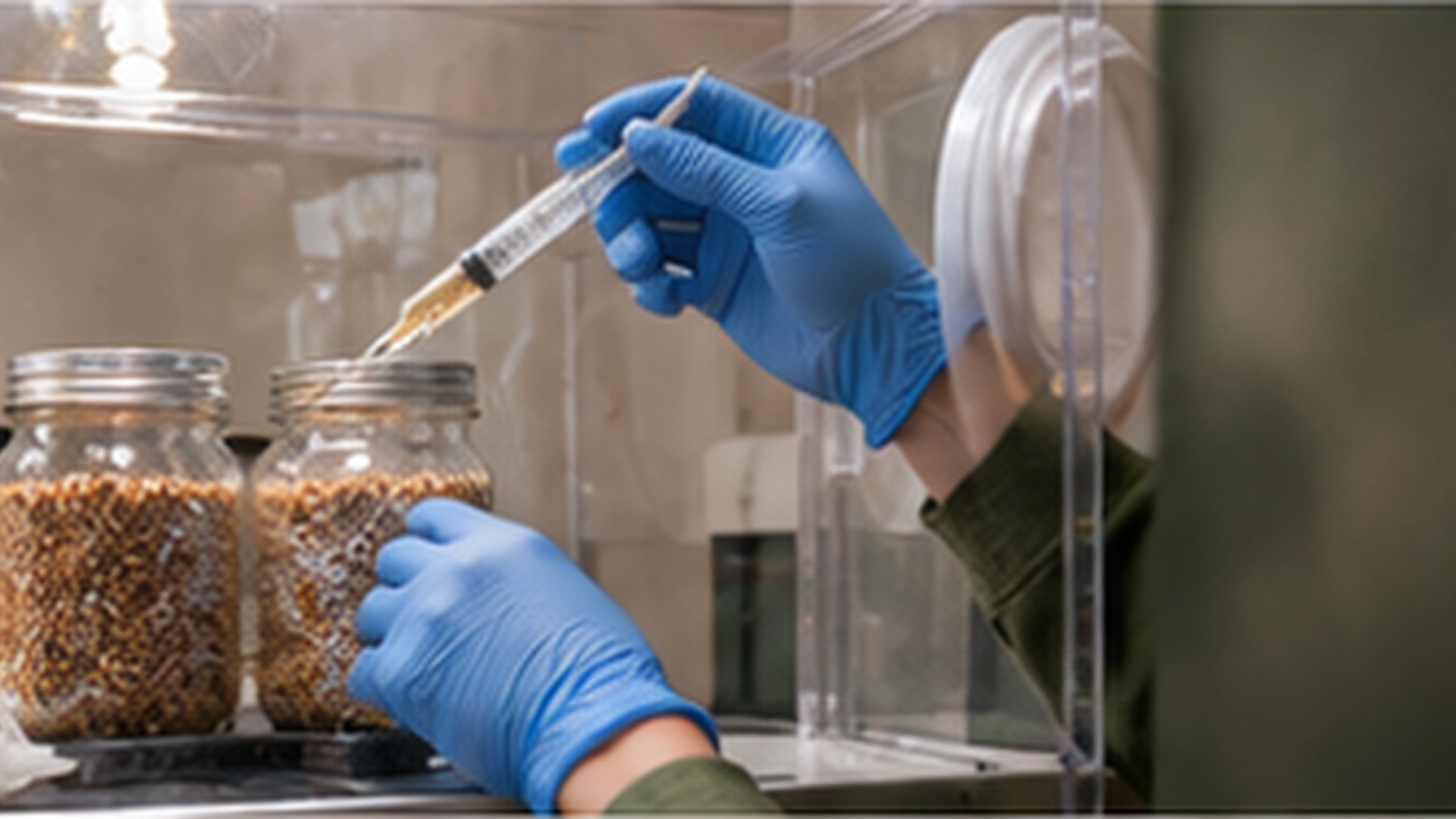
Every grower meets contamination sooner or later. The key is spotting it early, knowing what it is, and understanding what caused it so it does not happen again. This guide covers the most common contaminants in gourmet mushroom cultivation and how to tell them apart from healthy mycelium.
First: what healthy mycelium looks like
Healthy gourmet mycelium is white or off-white. It can be fluffy and cotton-like, or grow in thick, rope-like strands. Some colour changes are normal and not a sign of contamination:
- Yellow or amber droplets (metabolites) on oyster and other species are a natural by-product of growth.
- Brown patches on shiitake blocks are part of the normal “browning” stage before fruiting.
- Pinkish tints on lion’s mane are usually caused by cold or light, not contamination.
- Thin, wispy growth is normal for lion’s mane, which grows less densely than oyster.
Green mould (Trichoderma)
The most common contaminant. It often starts as a patch of white mycelium that looks almost like the mushroom’s own, then turns bright green or blue-green as it produces spores. It spreads quickly and can take over a whole block. Causes include poor sterile technique, under-pasteurised substrate, or overly wet conditions.
Blue-green mould (Penicillium)
Similar to Trichoderma but usually blue-grey to blue-green with a powdery look, often appearing as small spots rather than spreading patches. It is common on agar and in grain, and usually comes from airborne spores during inoculation.
Black mould (Aspergillus and others)
Black or dark grey powdery growth, sometimes with a yellow or green tint. Some species are a health risk, particularly to people with weakened immune systems or lung conditions. Do not open containers with black mould indoors.
Cobweb mould
Fine, grey, wispy growth that looks like cobwebs and spreads very fast across the surface of a substrate, often overnight. It is usually caused by high humidity and poor air exchange in the fruiting stage. Unlike most contaminants, small patches can often be treated by spraying with a dilute hydrogen peroxide solution and improving airflow.
Pink or orange mould (Neurospora)
Bright orange or pink and extremely fast-growing, sometimes pushing through filter patches. It is very hard to get rid of once it gets into a grow space, so bag and remove affected containers immediately.
Bacteria
Bacterial contamination shows as slimy, wet-looking, grey or yellowish areas, cloudy liquid culture, or grain that looks shiny and greasy. It usually smells sour, like rotten apples or vomit. The most common cause in grain is too much moisture, either from overcooking or not drying the surface properly. In liquid culture, cloudiness that does not settle is a warning sign.
What to do when you find contamination
- Do not open it indoors. Opening a contaminated container releases spores that can spread to the rest of your grow.
- Seal and remove it. Put it in a bag outside your grow area. Contaminated substrate can go in an outdoor compost heap, well away from your workspace.
- Clean reusable containers outdoors, or sterilise jars in the pressure cooker before washing.
- On agar, you can often rescue a culture by transferring clean mycelium from the edge furthest from the contamination to a fresh plate.
Preventing it next time
- Work in still air, using a still air box or flow hood.
- Wipe everything with 70% alcohol, and flame tools between uses.
- Get grain hydration right: fully hydrated inside, dry on the surface.
- Run cultures through agar to check they are clean before expanding them.
- Use higher spawn rates so the mycelium colonises faster than competitors.
- Keep notes, so you can trace problems back to a specific batch or step.
This guide covers edible gourmet species only. Cultivating psilocybin-containing mushrooms is illegal in the UK, and our microscopy spore samples are not sold for cultivation.
Leave a Reply